Time Zone Strategies for Digital Nomads Working with UK Clients
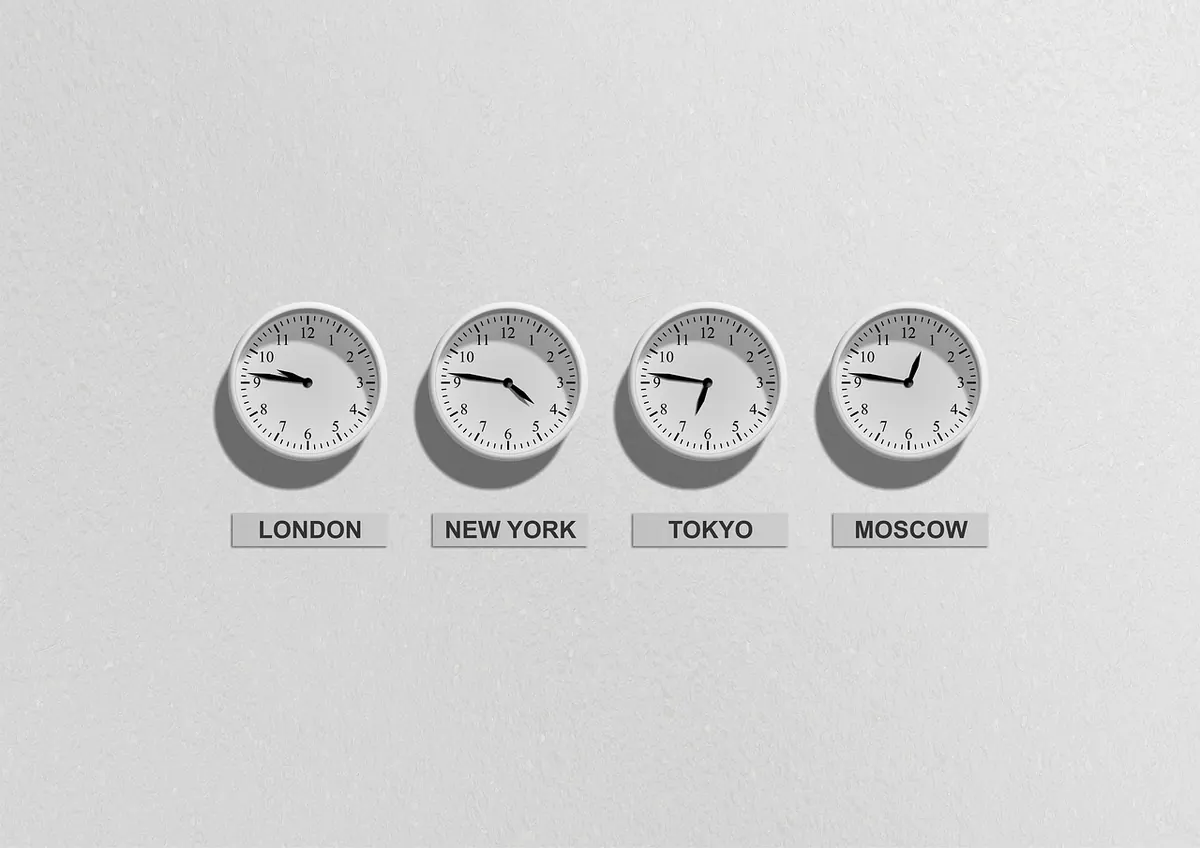
Your UK colleagues start their day as you're finishing yours. That single fact shapes more of nomad life than rent, wifi or visa runs, and it's usually the thing people plan for least.
The good news is that a time zone gap is a design problem rather than a personality test. You don't need superhuman discipline or a willingness to take every call at midnight. You need to know your real overlap, protect it, and move everything else into writing.
Work out your real overlap first
Start with honest maths. Most UK teams are only genuinely reachable between about 10:00 and 16:00 UK time. Before ten there's the commute and the inbox; after four, people are drifting towards school pick-up and the last push of the day. Treat those six hours as your working window, not 09:00 to 17:30.
From Lisbon that window is 10:00 to 16:00 local, barely a change from office life. From Cape Town it's 12:00 to 18:00, an hour earlier in summer. From Bali it's 18:00 to midnight in winter, 17:00 to 23:00 once British Summer Time kicks in. From Mexico City it's roughly 04:00 to 10:00.
Two things to keep in mind. The UK shifts its clocks in late March and late October, so check the offset twice a year rather than trusting what you memorised in January. And "reachable" isn't the same as "working" — a colleague might reply at 08:30, but that doesn't mean they'll thank you for scheduling a call then.
Write your overlap down somewhere you'll see it. It's a design constraint, like bandwidth or budget.
Three rough bands of difficulty
The easy band: Europe, the Middle East and Africa
Portugal, Morocco, Greece, Georgia, Kenya, South Africa. You can keep something close to a normal working day and still join the 10am call without rearranging your life. If your role is meeting-heavy — sales, project management, anything client-facing — this is where you want to be.
The workable band: the Americas and South Asia
Mexico City, Medellín, Buenos Aires, Bangalore, Colombo. You lose either your mornings or your evenings, never both. A 15:00 UK meeting is 09:00 in Mexico City and 20:30 in Bangalore during the winter months. The trick here is to accept the asymmetry and build your day around it rather than pretending it doesn't exist.
The demanding band: Asia-Pacific and the US west coast
Bali, Bangkok, Sydney, Vancouver, Los Angeles. Here, synchronous work means either very early or very late, and the sensible move is to shrink the number of live conversations rather than fight the clock. Plenty of people do it happily — but usually because they've negotiated an async-first role, not because they're unusually tough.
Design your day in blocks, not hours
A schedule that works from UTC+8 looks nothing like a UK office day. Take Bali, seven or eight hours ahead depending on the season. A workable pattern might run like this:
- 07:00–11:00 — deep work. Nobody in the UK is looking for you, and the connection is at its best.
- 11:00–17:00 — the life you moved for. Lunch, swimming, errands, a long walk, a nap if you need one.
- 17:00–18:30 — async reviews, comments, prep for the evening's calls.
- 18:30–23:00 — the live window. Stand-ups, calls, anything that needs a face.
- 23:00 — shutdown, and write tomorrow's handover note while it's still fresh.
Being honest about the cost matters. That last block is late, and doing it five nights a week will wear you down. If your role needs it daily, either negotiate fewer live commitments or move west.
Make async the default
The teams that cope best across big gaps are the ones where writing is normal, not a fallback. A few habits do most of the work:
- Write your handover before you log off, not when you wake up. Your evening is their morning.
- Keep one thread per topic. Long email chains and scattered DMs are how decisions get lost overnight.
- State what you need and by when. "Can you check the figures by Thursday?" beats "Let me know your thoughts".
- Use short screen recordings for anything visual. Five minutes of screen share saves a week of confused messages.
- Mark updates "no reply needed" so people don't feel obliged to answer at 22:00.
- Keep a running decision log. Anyone joining late can read the reasoning instead of asking for it again.
- Batch your replies into two or three set times rather than checking constantly.
The aim isn't to avoid people. It's to make sure the conversation survives you being asleep.
Make every meeting earn its place
Every synchronous hour costs someone, and if you're the one eight hours ahead, it usually costs you. So be deliberate about which calls you attend.
Keep meetings to 25 or 50 minutes, put an agenda in the invite, and prefer three people over eight. Record anything that matters so the person who couldn't attend at 23:00 isn't permanently behind. If your team rotates the awkward slot, make sure it actually rotates — the same person quietly absorbing every late call is how resentment starts. And protect one no-meeting day a week; it's the only reliable deep work you'll get.
A useful test: could this be a document with comments? If the answer is "we need to decide something", hold the meeting. If it's "we need to tell people something", write it down.
Protect your sleep and your evenings
Late calls are fine occasionally and corrosive weekly. Keep a fixed wake time even when your schedule is odd, get daylight early in the day, and be careful with caffeine after mid-afternoon. Blackout curtains are not an indulgence if you're finishing work at 23:00.
Watch for the slow drift: one 21:00 call becomes a habit, then a 22:30 call, then checking messages in bed. If you're regularly sleeping badly for weeks on end, treat it as a health matter and speak to a GP or another qualified professional rather than trying to schedule your way out of it.
Set it up in your first fortnight
If you're starting a new contract or moving to a new zone, do this in your first two weeks:
- Confirm the team's real core hours in writing — not the ones in the handbook, the ones people actually keep.
- Ask which meetings are genuinely mandatory and which you can read about afterwards.
- Publish your working hours in your calendar and your email signature, with the offset spelled out.
- Agree a response-time expectation: within one working day, not within an hour.
- Block your live window and treat it as fixed, so nobody assumes you're available at 07:00.
- Review after a month. Most schedules need one adjustment once you know where the friction is.
The goal isn't to be available. It's to be reliable, and across a six-hour gap those are very different things.
Photo: jarmoluk / Pixabay